Deans of Agriculture lead in Transforming University–Industry Collaboration in Kenya
From Leadership Dialogue to National Action

Agriculture remains Kenya’s economic backbone, feeding millions, creating jobs, and sustaining rural livelihoods. Yet for years, a familiar gap persisted: universities trained graduates, while industry struggled to find job-ready skills.
In 2024, a national effort was launched to narrow that disconnect in a visible and coordinated way. At the center of this shift was the University Deans of Agriculture Forum, a leadership platform that moved collaboration beyond isolated engagements and into sustained, action-oriented dialogue.
The Deans’ Forum: Where Change Began
- Kenyatta Univ.
- Chuka Univ.
- Taita Taveta Univ.
- Mount Kenya Univ.
- Egerton Univ.
- Univ. of Nairobi
- Jomo Kenyatta Univ. of Agriculture and Technology
- Maseno Univ.
- South Eastern Kenya Univ.
- Pwani Univ.
- Karatina Univ.
- University of Eldoret
- Meru Univ. of Science and Technology
- Tharaka Nithi Univ.
- Masinde Muliro Univ.
- Machakos University
- Univ. of Kabianga
- Univ. of Eastern Africa, Baraton
- Jaramogi Oginga Odinga Univ.
- Embu Univ.
- UMoi Univ.
- Kisii Univ.
- Murang'a Univ.
- Laikipia Univ.
- Turkana Univ.
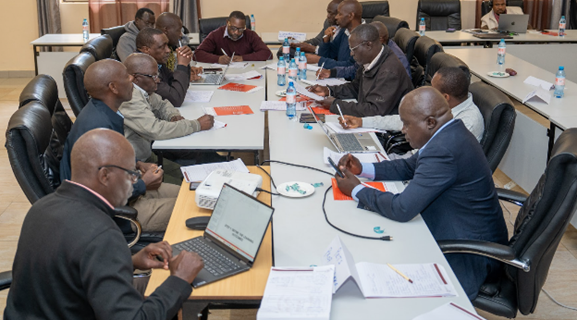
The University Deans of Agriculture Forum, launched in 2024 with support from UPLIFT‑Ag project and the Agriculture Sector Network (ASNET), isn’t just another gathering. Through 2025, it evolved into a regular, action‑oriented conversation space where academic leaders, industry players, and government began shaping practical solutions together.
By year’s end, the forum had onboarded leaders from 25 universities teaching agriculture across Kenya (Box 1). The forum created a rare space where senior academic leaders could speak collectively rather than institution by institution. The Dean’s forum has held meeting with industry networks facilitated by the Agriculture Sector Network (ASNET) and government officials to talk about real challenges, including:
- Aligning curricula with labour market needs
- Co-designing training with industry input
- Preparing graduates for a rapidly changing agribusiness sector
What makes the forum distinctive is its consistency and intent: discussions have not been abstract, but anchored in real sector demands and policy realities.
From Academic Dialogue to National Policy Engagement
A defining moment that stood out in November 2025 was when members of the Deans’ Forum joined hands with the President’s Economic Transformation Secretariat in a session that marked a shift in how universities position themselves from mere observers to contributors of solutions through impactful agriculture policy formulation.
Together, deans, policy makers and industry representatives explored ideas and co‑developed joint proposals for promoting agriculture as an engine for jobs, enterprise, and national growth.
This was more than a meeting; it marked a shift toward university leadership feeding into national strategy, acknowledging that universities must be part of the solution, rather than spectators during policy discussions.
Extending the Conversation: The National Agribusiness Summit 2025
The influence of the Deans’ Forum became even more visible during the 2025 National Agribusiness Summit held in October in Nairobi. The Summit, repositioned as a public‑private dialogue platform, brought together government, private sector actors, youth, counties, development partners, and academia to shape the next wave of agricultural transformation in Kenya.
Under the theme “From Promise to Action: Advancing Agribusiness through Dialogue and Innovation,” the summit recognized that agriculture is no longer just about production, it is about value addition, investment, digital solutions, and youth employment.
Unlike past summits, the 2025 event wasn’t just talk, it had policy commitment sessions, executive roundtables, an agribusiness expo, and the National Agribusiness Excellence Awards that celebrated innovators and leaders across the sector.
At the summit, national leaders emphasized that agriculture must feed the economy and drive enterprise. Kenya’s top policymakers reiterated that building efficient value chains, investing in technology, and strengthening public‑private partnerships are central to the country’s economic transformation plan.
This creates a unique moment where policy dialogue intersects with action, and the Deans’ Forum sits right at that convergence, bringing academic insight into the national spotlight.

Deans of Agriculture with other participants at the side event, (National Agribusiness Summit 2025).
Students, Innovators, and a New Generation of Changemakers
What made the summit especially thrilling was the presence of young innovators and students.. These students didn’t just sit at the back; they pitched ideas, showcased innovations, and engaged in lively conversations with judges and industry leaders directly, signaling a new era of youth‑driven agribusiness thinking.
Their energy underlined a simple fact: tomorrow’s agriculture leaders are already stepping forward today.

Young innovators and students pitching their ideas during the National Summit with the judges, Deans Forum Chaired the session.
Early Outcomes of the Deans’ Forum in Kenya
By the end of 2025, the Deans of Agriculture Forum had firmly moved from conversation to action.
Universities are now engaging industry and government through structured, regular dialogue rather than one-off meetings. This shift has helped align training with real agribusiness needs.
The Forum is also opening new pathways for students, linking learning to internships, innovation challenges, and practical exposure.
At national level, Universities have gained a seat at policy dialogues, reinforcing academia as an indispensable partner in Kenya’s agricultural transformation.
Together, these early outcomes show how academic leadership can translate dialogue into real-world impact.
Looking Ahead: Sustaining the Momentum Beyond 2025
As 2025 closed, Kenya’s agriculture scene has been shifting. What began as discussions are turning into shared commitments, partnerships, and pilot initiatives that promise measurable impact.
The Deans’ Forum, once an idea, now helps steer national conversations. The National Agribusiness Summit has become a platform where dialogue meets action. Importantly, students (the next generation) are already taking the lead.
In Kenya, the future of agriculture is becoming more interconnected, more innovative, and more driven by those who live, eat, and work in the sector every day.
Acknowledgements
The establishment and operation of the University Deans of Agriculture Forum in Kenya was through collaboration with Chuka University and Taita Taveta University, the core national partners in convening the forum.
The activities were supported by KeFAAS as a key partner of the UPLIFT project in Kenya.
The UPLIFT-Ag project is funded by the European Union and implemented in partnership with nine universities in Kenya, Rwanda, Burundi, and Zimbabwe, and three European higher education institutions in Germany, Italy, and Denmark.


UPLIFT Project, University–Industry Linkages, EU-funded, Project updates, Kenya, Deans Forum, Annual Reports, Taita Taveta University, Kenyatta University
Project Coordinator:
Prof. Maina Mwangi
School of Agriculture and Environmental Sciences
Kenyatta University
Tel: +254710860550
Email: maina.mwangi@ku.ac.ke