Rethinking Agriculture Training: Universities Review Their Curricula for Industry Relevance


This project is co-funded by the European Union.
Across Africa, agriculture remains a key driver of livelihoods, food security, and economic growth. Yet for many graduates, transitioning from university to the workplace has remained a challenge. Employers continue to raise concerns about skills gaps, limited practical exposure, and curricula that no longer reflect the realities of modern agriculture.
It is evident that university training has not kept pace with the evolving needs of the agriculture sector.
New technologies, climate pressures, changing markets, and expanding agribusiness opportunities require graduates with updated skills and stronger practical awareness. Recognizing this, the UPLIFT Agriculture (UPLIFT-Ag) Project has supported partner universities to review and modernize agriculture curricula ensuring programmes are aligned with industry realities and national development priorities.
In the UPLIFT-Ag project curriculum review is the major milestone under Work Package 3, bringing together institutions across Kenya, Rwanda, Burundi, and Zimbabwe in a shared effort to strengthen agriculture training, with technical support from the EU partners (HNU in Germany, UNIVPM in Italy and UCPH in Denmark).
- Partner universities in Kenya, Rwanda, Burundi, and Zimbabwe reviewed agriculture curricula to strengthen industry relevance.
- Kenyatta University reviewed 40 programmes, strengthening university–industry linkages.
- Chuka University revised 35% of its BSc Agriculture curriculum to address emerging sector needs.
- Taita Taveta University secured accreditation for new agriculture programmes, while partners in Rwanda (UR, UNILAK) and Burundi (Ngozi University, University of Burundi) advanced stakeholder-led curriculum reforms.
- Chinhoyi University of Technology and Zimbabwe Open University strengthened programme structures to support graduate employability and sector innovation.
A Consortium-Wide Push for Updated and Responsive Curricula
Curriculum reform under UPLIFT-Ag has been driven by collaboration rather than isolated institutional efforts. During the 2nd Annual Consortium Meeting held in Nyanga, Zimbabwe, partners reflected on progress, shared experiences, and reinforced the importance of industry engagement in curriculum .design. This collective approach has helped universities identify gaps, update course content, and ensure agriculture programmes remain relevant to labour market needs.
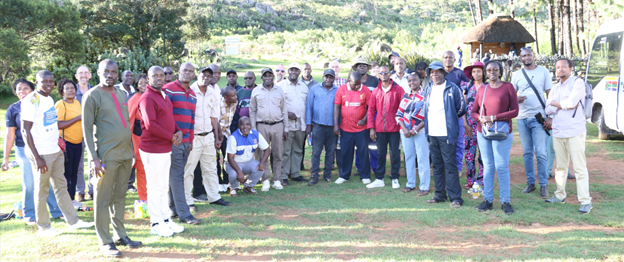
Uplift-Ag project members during the annual conference in Nyanga, Zimbabwe with the main theme of improving curriculum and teaching methods.
Curriculum Review Achievements across UPLIFT-Ag Universities
Kenyatta University (Kenya): Reviewing 40 programmes with industry roles built in
At Kenyatta University (KU), curriculum review was undertaken at significant scale. By mid-2025, the School of Agriculture and Environmental Sciences had reviewed and submitted 40 agriculture-related programmes for Senate consideration. A key focus was strengthening university–industry linkages through clearer frameworks within curricula. KU identified specific entry points where industry actors can contribute meaningfully, including structured engagement in training, mentorship, attachments, and sector-informed input. The curriculum reforms at KU are aligned to the university Strategic Plan (2023–2027) goals of industry collaboration in teaching and research. The process is ensuring the curriculum changes are institutionally owned and sustainable beyond the project period. In addition, KU initiated improvements in postgraduate training guidelines, including stronger emphasis on innovation, relevance, and research aligned with development priorities.
Chuka University (Kenya): Updating the Bsc. Agriculture curriculum to reflect emerging needs
At Chuka University, curriculum review focused on revising the Bachelor of Science in Agriculture programme. Stakeholder consultations highlighted gaps in coverage across agriculture sub-sectors, including the need to better address areas such as aquaculture, apiculture, and emerging high-value export crops. By June 2025, approximately 35% of the curriculum had been revised, within regulatory thresholds, ensuring the programme better reflects the diversity and evolution of the agriculture sector. The updated curriculum is expected to roll out following institutional approval processes.
Taita Taveta University (Kenya): Strengthening accredited agriculture programmes
Taita Taveta University (TTU) advanced curriculum development across undergraduate and postgraduate levels. Key milestones included accreditation of revised programmes in BSc Agricultural Education and Extension and PhD Crop Science. TTU also reviewed additional programmes aligned with food security and sector needs, reinforcing the university’s growing role in agriculture training and research.
University of Rwanda: Reviewing MSc Agribusiness with stakeholder input
The University of Rwanda (UR) undertook a structured review of its MSc Agribusiness curriculum. The process was launched in April 2025 with participation from faculty, external reviewers, alumni, and industry actors. A needs assessment identified priority competencies required in Rwanda’s agribusiness sector, ensuring the revised programme responds to national priorities and private sector expectations. Implementation is expected following completion of approval processes.
UNILAK (Rwanda): Developing a new Agribusiness curriculum
At the University of Lay Adventists of Kigali (UNILAK), curriculum reform focused on developing a new Bachelor of Science in Agribusiness programme. By July 2025, the curriculum had been submitted to the Higher Education Council for review. The programme reflects UNILAK’s commitment to preparing graduates for Rwanda’s growing agribusiness economy and strengthening private sector alignment.
University of Burundi: Validating gaps and priorities for curriculum improvement
In Burundi, the University of Burundi conducted consultations to validate findings from baseline assessments. A workshop held in February 2025 brought together stakeholders to identify curriculum gaps and priority areas for improvement. The process laid the foundation for ongoing reforms aimed at strengthening relevance and graduate readiness.
University of Ngozi (Burundi): Strengthening curriculum frameworks and quality assurance
The University of Ngozi advanced curriculum review through consultative workshops held in 2025. Alongside programme improvements, the university focused on strengthening internal frameworks that support curriculum quality, including governance and quality assurance processes.
Chinhoyi University of Technology (CUT, Zimbabwe): Revising doctoral training in agriculture
At CUT, curriculum reform was centered on revising the guidelines for Doctoral training programme in Agriculture. Stakeholder engagement highlighted the importance of interdisciplinary research, industry relevance, and stronger structures within doctoral training. The revised guidelines is expected to progress through approval stages by the end of 2025.
What Made These Curriculum Reviews Different
Unlike traditional curriculum review processes, UPLIFT-Ag approach emphasizes early and active industry engagement. Industry actors are to be involved not only in validation workshops but also in identifying skills gaps, shaping course content, and advising on delivery approaches. Curricula were redesigned to balance technical, entrepreneurial, and functional skills; increase opportunities for hands-on learning and reflect real challenges faced along agricultural value chains. This approach ensures that curriculum reforms are grounded in practical realities rather than theoretical assumptions.
Looking Ahead: Curriculum Reform as the Foundation for Transformation
Curriculum review has marked an important first step in UPLIFT-Ag project’s broader effort to modernise agriculture training. Building on these reforms, partner universities are now advancing innovative teaching methods, investing in facilities, and developing curriculum guidelines to support long-term, system-wide change.
UPLIFT Project, University–Industry Linkages, Chinhoyi University of Technology, EU-funded, Zimbabwe Open University, UNILAk, Taita Taveta University, Kenyatta University, Chuka university, University of Rwanda, Curriculum review, Higher Education, Skills development, Africa Agriculture, Agriculture Education
Project Coordinator:
Prof. Maina Mwangi
School of Agriculture and Environmental Sciences
Kenyatta University
Tel: +254710860550
Email: maina.mwangi@ku.ac.ke